Ignorance more frequently begets confidence than does knowledge. ----Charles Darwin
Background
Egged on by my wife on a whim, I decided to travel around Southeast Asia during my break and improve my English along the way. To make sure the learning actually paid off, I decided to measure the results with an IELTS score. Young and naive as I was, I set myself a goal of IELTS 7.5.
Preparation Plan
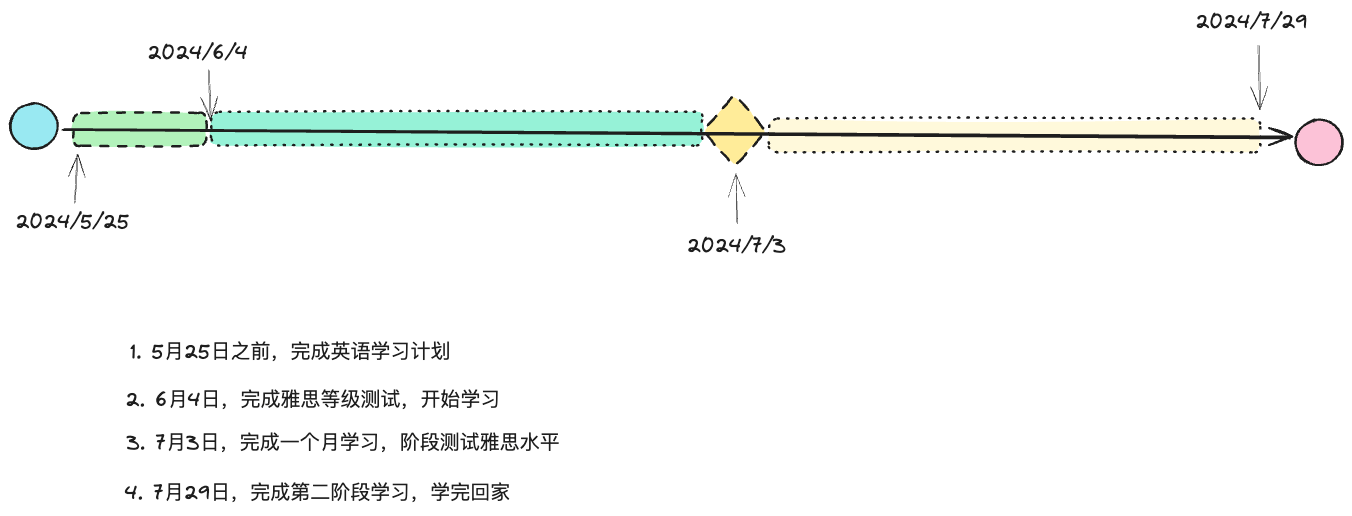
The whole preparation period consists of four phases:
- May 24 – May 30: preparation phase — research, planning, brushing up on grammar and basic vocabulary
- May 31 – June 3: trial classes, choosing a language school
- June 4 – July 3: complete the first phase of study
- July 4 – July 30: complete the second phase of study and take the exam
Weekly Plan
Week 1
- Key items: research & planning & grammar & vocabulary
- Goal: Get familiar with the IELTS exam format and scoring criteria, and make a detailed study plan
- Course:
- Learn the exam format and scoring criteria of the four IELTS sections
- Assess my own English level and make a detailed study plan
- Learn about IELTS preparation resources and study techniques
- Output:
- -雅思考试考什么
- 英语综合能力测试-2024
- 马来西亚语言学校怎么选?
- 8周雅思7.5分冲刺计划
- -我的英语雅思备考资源
- BestGift
Week 2: Vocabulary & Grammar
- Key items: memorize vocabulary, train the ear
- Goal: Build a solid foundation in vocabulary and grammar, raising vocabulary size to 4000 -> 4500+
- Complete the band-6 vocabulary list (2,000 words)
- Course:
- Memorize xxx high-frequency words every day and practice with example sentences
- Study basic grammar and do exercises
- Practice basic IELTS listening and reading question types
Week 3: Listening & Reading
- Goal: Improve listening and reading speed and accuracy
- Course:
- Do intensive listening practice every day and analyze why answers were wrong
- Do intensive reading practice every day and practice speed-reading techniques
- Practice medium-difficulty IELTS listening and reading question types
Week 4: Listening & Reading
- Goal: Master IELTS listening and reading test-taking techniques
- Course:
- Learn IELTS listening techniques, such as note-taking and prediction
- Learn IELTS reading techniques, such as scanning and locating
- Practice difficult IELTS listening and reading questions
Week 5: Speaking & Writing
- Goal: Improve writing and speaking skills
- Course:
- Learn the IELTS writing question types and scoring criteria
- Practice different IELTS writing question types and have a teacher grade them
- Learn the IELTS speaking question types and scoring criteria
- Practice different IELTS speaking question types and get feedback from a teacher or friend
Week 6: Speaking & Writing
- Goal: Get familiar with the procedures and techniques of the IELTS writing and speaking exams
- Course:
- Simulate the IELTS writing exam to get familiar with the exam procedure and time allocation
- Simulate the IELTS speaking exam to get familiar with the exam procedure and scoring criteria
- Practice common topics in the IELTS writing and speaking exams
Week 7: Filling the Gaps
- Goal: Identify and fill gaps, strengthening weak areas
- Course:
- Take IELTS mock exams to check the effectiveness of the review
- Analyze results from previous mock exams to find weak areas
- Make a targeted review plan, focusing on the weak areas
Week 8: Facing the Exam
- Goal: Adjust my mindset and get ready for the exam
- Course:
- One more mock exam: take the final full mock exam and make final adjustments
- Relax and review: stay relaxed while reviewing, making sure I’m in my best shape
Project Management
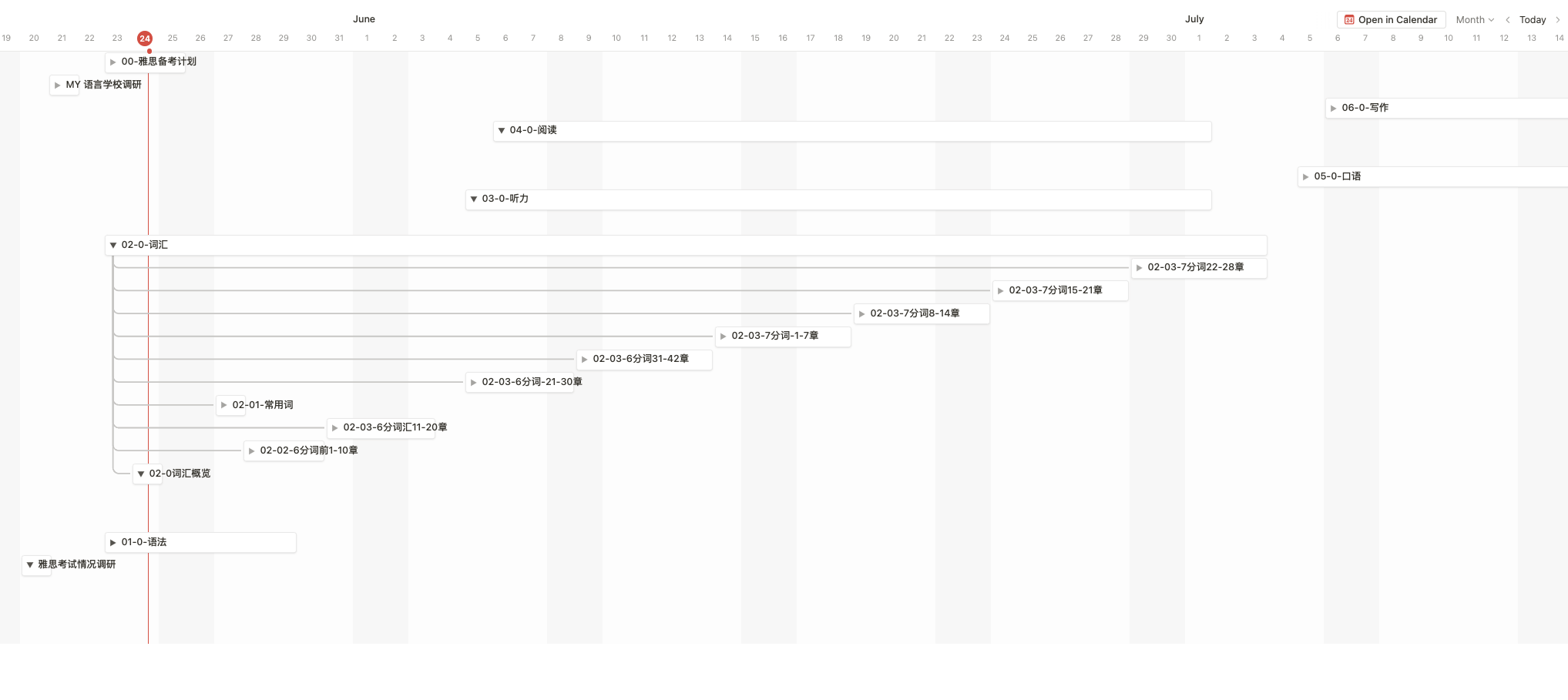
This time I’m treating IELTS preparation as a project, using Notion to manage the key tasks. The Timeline view looks roughly like this. Right now it only contains the subtasks for the vocabulary part; tasks for the other modules will be coordinated once the language school is decided, based on the school’s course schedule and my existing resources.
Follow the WeChat official account Tech Backyard for more information.