💡 Founder of Scratch, Professor of Learning Research at the MIT Media Lab, global director of LEGO Education, and one of the founders of the LEGO education philosophy.
Creative Learning
Roughly two-thirds of today’s elementary school students will end up working in jobs that haven’t been invented yet. To thrive in such a rapidly changing world, the ability to think and act creatively has become more important than ever.
From Type A to Type X
- Type A: rule-following, conventional, executing, compliant
- Type X: creative, open-minded
Learning Like Kindergarten
The world’s first kindergarten —> Maria Montessori
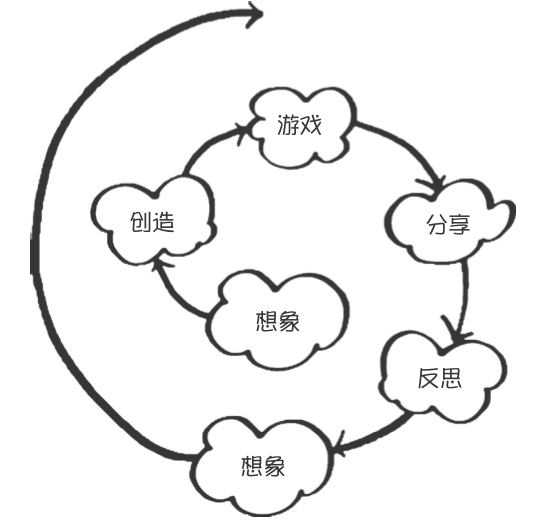
The 4P Learning Theory
- Project: Creating projects is the core activity of the Scratch community. When MahoAshley used Scratch, she kept creating projects and, through repeated cycles of the Creative Learning Spiral, gained a deep understanding of the creative process.
- Passion: When people work on projects they care about, they are often willing to spend more time and work harder
- Peer: People collaborate, share, and build on each other’s work
- Play: Playful experimentation cultivates young people’s creativity and encourages them to take risks and try new things
What Creativity Is, and What It Is Not
Misconceptions about creativity
- Creativity is only a form of artistic expression
- Only a small number of people are creative
- Creativity comes from moments of insight
- Creativity cannot be taught
Creativity comes from a certain kind of hard work — one that combines curious exploration, playful experimentation, and systematic investigation. New ideas and insights may appear to strike like lightning, but they usually emerge after many cycles of imagining, creating, playing, sharing, and reflecting — that is, after many iterations of the Creative Learning Spiral.
All children are born with creative potential, but their creativity does not necessarily develop on its own — it needs to be nurtured, encouraged, and supported.
Project
Projects are the basic unit of creative learning, a whole new way to experience and engage in creative learning. Only when children are immersed in creating and making projects do they have the chance to grow into creative thinkers.
Learning through creating — learning by doing.
🤵🏼♂️ Seymour Papert
- The computer is not a substitute for the teacher, but a new medium of expression, a new tool for making things
- In the process of learning to program, children “both gain a sense of mastery over the most modern and powerful of technologies, and establish an intimate connection with some of the deepest ideas of science, mathematics, and the art of intellectual model building”
- Programming is a fluent form of expression
How do you tell which toys are good for your child?
- Don’t ask what the toy can do for your child; ask what your child can do with the toy.
- Compared to toys that can think, I’m interested in toys that make children think. If children can use a toy to imagine and create their own projects, immersing themselves in the Creative Learning Spiral, then that is the kind of good toy that excites me.
Writing and programming are both forms of expression, ways of communicating ideas with others.
Expressing yourself more fluently, whether through writing or through programming, can help you develop your thinking, make your voice heard, and build your sense of identity.
Passion
Interest and intrinsic motivation are the keys to creativity and long-term persistence. Education is not filling a bucket, but lighting a fire.
Low floor, high ceiling, wide walls.
When people work on projects they are interested in, they become more engaged, willing to invest more time and put in more effort. More than that, passion and motivation make them more likely to spark new ideas and develop new ways of thinking.
The best learning experiences include alternating phases of immersion and reflection; passion is the fuel that drives the “immersion–reflection” cycle.
Rewards can bring short-term boosts, just as a caffeine kick can keep you going for a few more hours. But the effect fades over time and, worse, it undermines a person’s long-term motivation to keep working on the project.
Personalized Learning
I hope learners can have more control over how, what, when, and where they learn. When learners have more choice and control, learning can be built on a foundation of interest and passion, becoming more personal, more motivated, and more meaningful.
Peer
Most thinking processes are connected with other people; we share ideas with each other, get feedback from our peers, and draw on each other’s inspirations.
Co-creation —>
What should a community do???
When people feel that the peers around them care about and respect them, they are more likely to try new things and take risks — and risk is an essential part of the creative process.
The four roles a good teacher needs to play
- Catalyst: asking questions to spark students’ imagination and creative thinking
- Consultant: guiding from behind the scenes rather than providing the best answer up front
- Connector: connecting students with others to broaden their horizons
- Collaborator: co-creating together with students
Play
Play doesn’t require open-ended gadgets or expensive toys; it is a combination of curiosity, imagination, and experimentation, and creativity lies within it.
Creativity does not come from laughter and fun; it comes from experimentation, risk-taking, and pushing boundaries.
Play <—> Learning
Tinkering is a bottom-up process that begins with seemingly random exploration, but it doesn’t end there. True tinkerers know how to elevate their initial explorations from the bottom up, turning them into purposeful activities.
People with a growth mindset believe that intelligence is malleable; they recognize that they can keep learning and developing through hard work and dedication. As a result, they are willing to take on challenges, persist in the face of setbacks, and learn from their mistakes.
An Innovative Society
One way to help young people get ready to thrive in an innovative society is to make sure they have the opportunity to follow their interests, explore their ideas, and make their voices heard. I have championed these values in every era, and now they matter more than ever.
10 Tips for Learners
- Start with something simple
- Make things you love
- If you don’t know what to do, just tinker around
- Don’t be afraid to experiment
- Find a friend to collaborate with and share ideas
- It’s OK to copy to spark your own ideas
- Keep your ideas in a notebook
- Build it, take it apart, rebuild it
- Many things can go wrong — stick with it
- Create your own learning strategies
10 Tips for Parents and Teachers
- Imagine: show examples to spark ideas
- Imagine: encourage messing around
- Create: provide a variety of materials
- Create: embrace all types of making
- Play: emphasize the process, not the outcome
- Play: extend the time for projects
- Share: play the role of matchmaker
- Share: get involved as a collaborator
- Reflect: ask questions with genuine sincerity
- Reflect: share your own reflections
10 Tips for Designers and Developers
- Design for designers
- Support “low floor” and “high ceiling”
- Widen the walls
- Combine interests and ideas
- Prioritize simplicity
- Deeply understand the people you are designing for
- Invent things you yourself would want to use
- Build a small interdisciplinary design team
- Designing playful learning technologies requires interdisciplinary expertise, including computer science, electrical engineering, design, psychology, education, and more
- Control the design, but also make use of feedback from the crowd
- Iterate, iterate, and iterate again
The road to lifelong kindergarten will be long and winding, requiring work across many places, by many people, over a long time. We need to develop better technologies, activities, and strategies so that children can participate more in creative learning activities; we need to create more spaces where children can pursue their own creative projects and develop their creative capacities; and we need to come up with better ways to document and demonstrate the power of projects, passion, peers, and play.
Follow the WeChat official account 技术后花园 (Tech Backyard) for more