Documenting my preparation for the SJTU 2024 MEM interview, and sharing my Tier A interview experience.

If you are also preparing for the 2024 MEM program, feel free to add me on WeChat at imesong2012 with the note 交大MEM备考 (SJTU MEM prep), so we can study and encourage each other and get admitted together.
Register an Account
School of Electronic Information and Electrical Engineering, Shanghai Jiao Tong University
Preferred Interview System — Registration / Login
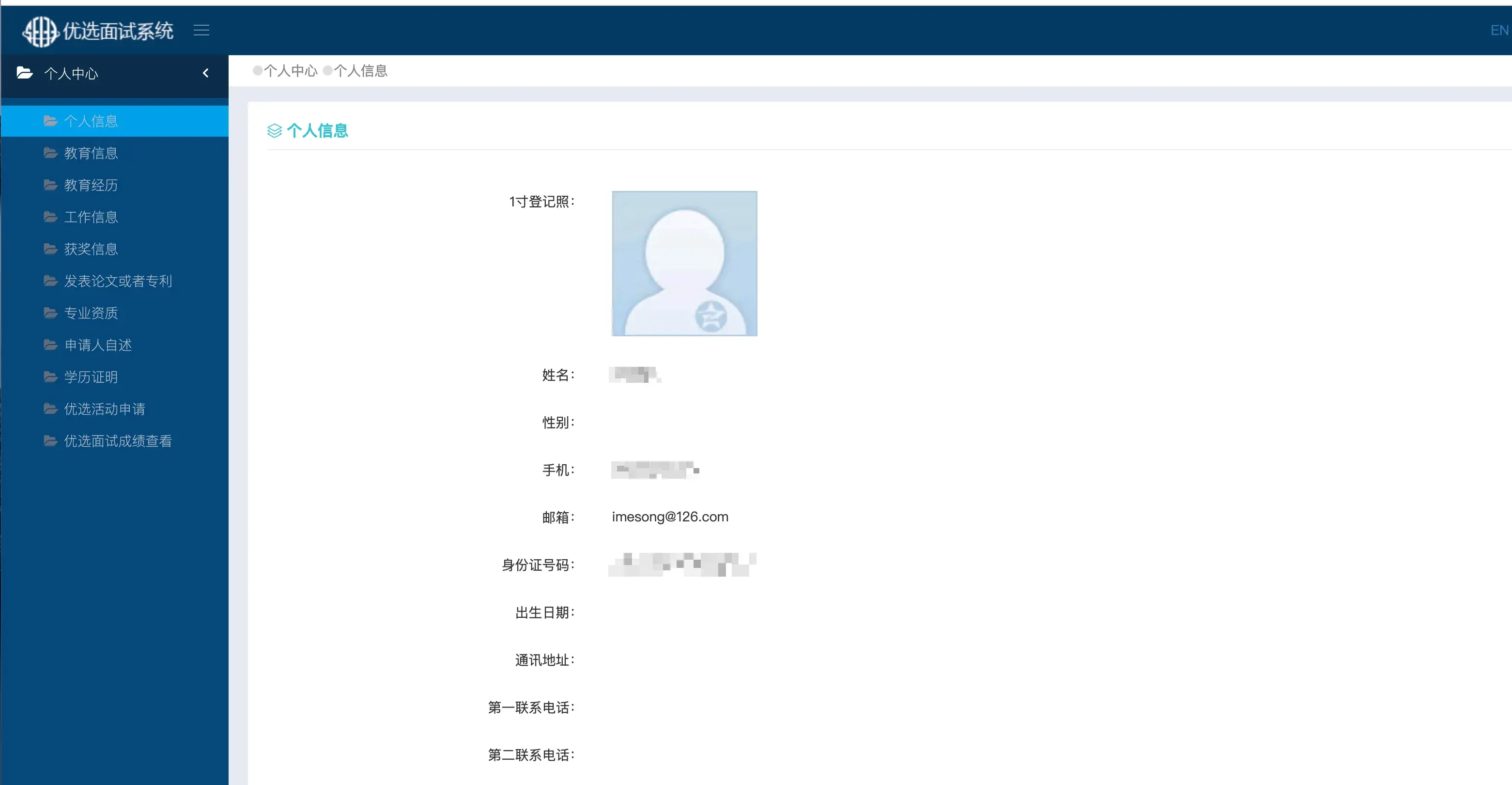
Writing the Basic Application Materials
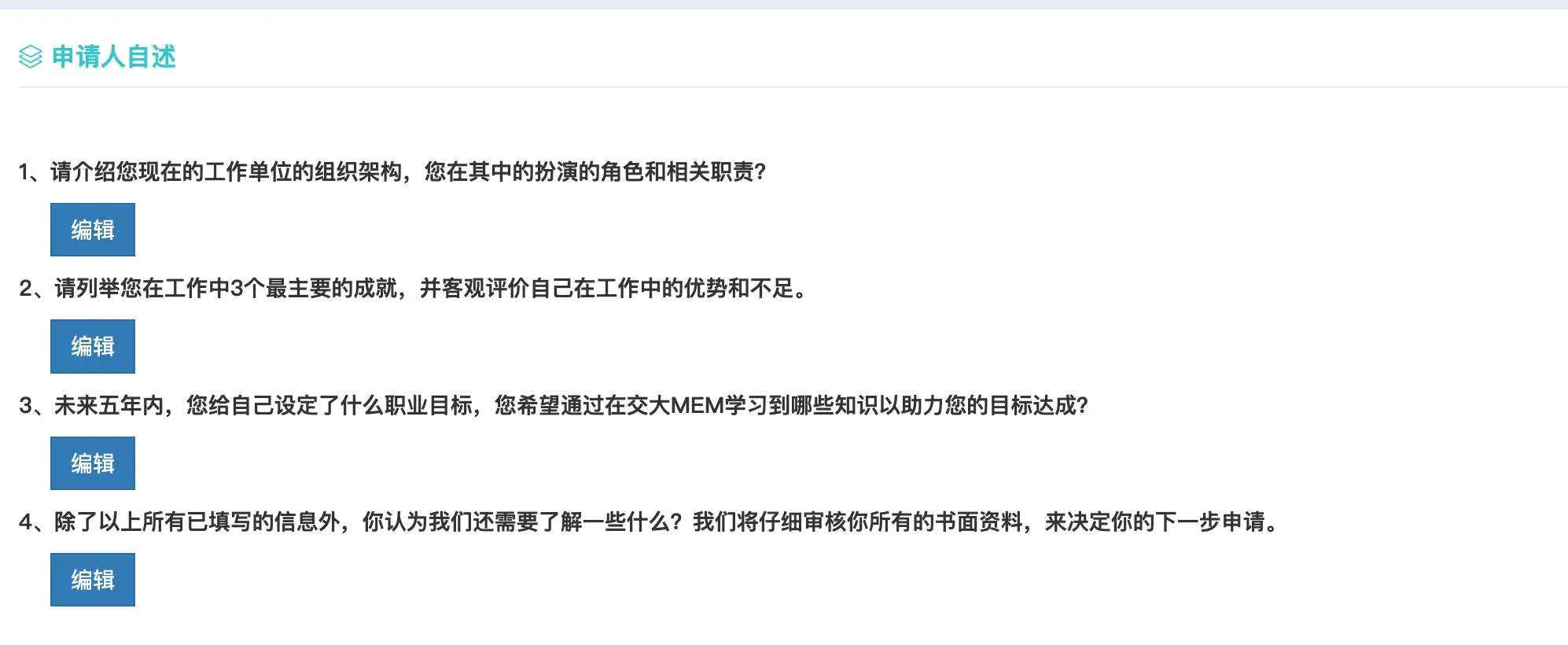
Applicant’s Personal Statement
The personal statement consists of four questions. I only answered the first three. Below is the material I prepared.
The organizational structure of your current employer, your role in it, and your related responsibilities
I currently work at Beijing ByteDance Technology Co., Ltd. as a client-side engineer, mainly supporting client-side development for TikTok’s international e-commerce business. The TikTok app is used by more than one billion people every day worldwide (excluding China), and TikTok e-commerce is one of the most important businesses in ByteDance’s international e-commerce portfolio.
TikTok e-commerce is currently expanding rapidly in Southeast Asia, the Middle East, Europe, and the Americas, with huge growth potential — and many challenges as well. In my team, I am mainly responsible for client-side development support for the Middle East, Europe, and the Americas markets. My main responsibilities include:
-
As the client-side tech lead for shelf-based e-commerce in the Middle East, Europe, and the Americas, supporting the business in hitting its core goals, including revenue, market share, and e-commerce penetration rate.
-
Leading the engineering team to ensure the delivery efficiency and quality of business requirements, and being accountable for engineering outcomes.
-
Making mid- to long-term plans for the client-side direction, keeping control of key technical points in the business, driving the evolution of the technical architecture, and raising the team’s technical influence.
-
Fostering a culture of proactive learning and sharing within the team, building a learning organization, and improving the team’s overall technical capability.
List your three most significant achievements at work, and objectively evaluate your strengths and weaknesses
-
As the client-side lead, I supported the international e-commerce business in entering the Middle East market, completing the build-out from 0 to 1 within two months. After launch, the business exceeded expectations on revenue, penetration rate, and customer feedback.
-
During my time at Shanghai 2345 Mobile Technology Co., Ltd., as one of the company’s client-side leads, I unified the underlying infrastructure across the company’s multiple mobile products — including base architecture, technology selection, technical solutions, and dependency management — improving app development efficiency and reducing business maintenance costs.
-
I do not draw boundaries around my role and I face technical challenges head-on, driving business growth through technology. As a client-side engineer, when the partner team was short-staffed, I led my team to proactively learn the cross-platform tech stack, and within two months we built and launched the operations configuration system, solving the problems of low efficiency and poor maintainability in marketing campaign configuration. Strengths
-
I have sound technical judgment at work. I can weigh business needs, time, labor costs, and risks to reasonably evaluate different technical solutions and find the optimal answer within a broader scope.
-
As an engineer, while supporting the business I also have a certain business sensitivity and product awareness. I can hold effective, thorough discussions with business stakeholders around core business goals, so that technical implementation better supports product requirements. Weaknesses
-
I am fairly cautious. When making plans and deciding on implementation approaches, I tend to be relatively conservative, lacking the boldness to break with the old and bring in the new; my innovation ability is somewhat insufficient.
-
My conflict-management skills at work are weak. I have little experience with “fighting things through”; I am more of a cooperative personality.
What are your career goals for the next five years, and what knowledge do you hope to gain from the MEM program at SJTU to help achieve them?
- In five years, I want to be capable of serving as the technical lead for complex products, leading multiple functional teams and handling both product development and team management.
- In five years, I want to have a deep understanding of my industry, a clear view of and plan for its future direction, and to become a fairly senior figure in the field.
- I hope that through the MEM program at SJTU I can broaden my technical horizons, understand industry trends, and round out my theoretical knowledge of management — including engineering management, project management, and supply chain management. Combined with my day-to-day management practice, I want to form my own management style and methodology.
- I hope to meet more outstanding teachers and classmates on the SJTU platform, and to do valuable things with excellent people, exploring more possibilities.
Beyond all the information you have already provided, what else do you think we should know about you?
- Nothing for now.
Submitting the Materials
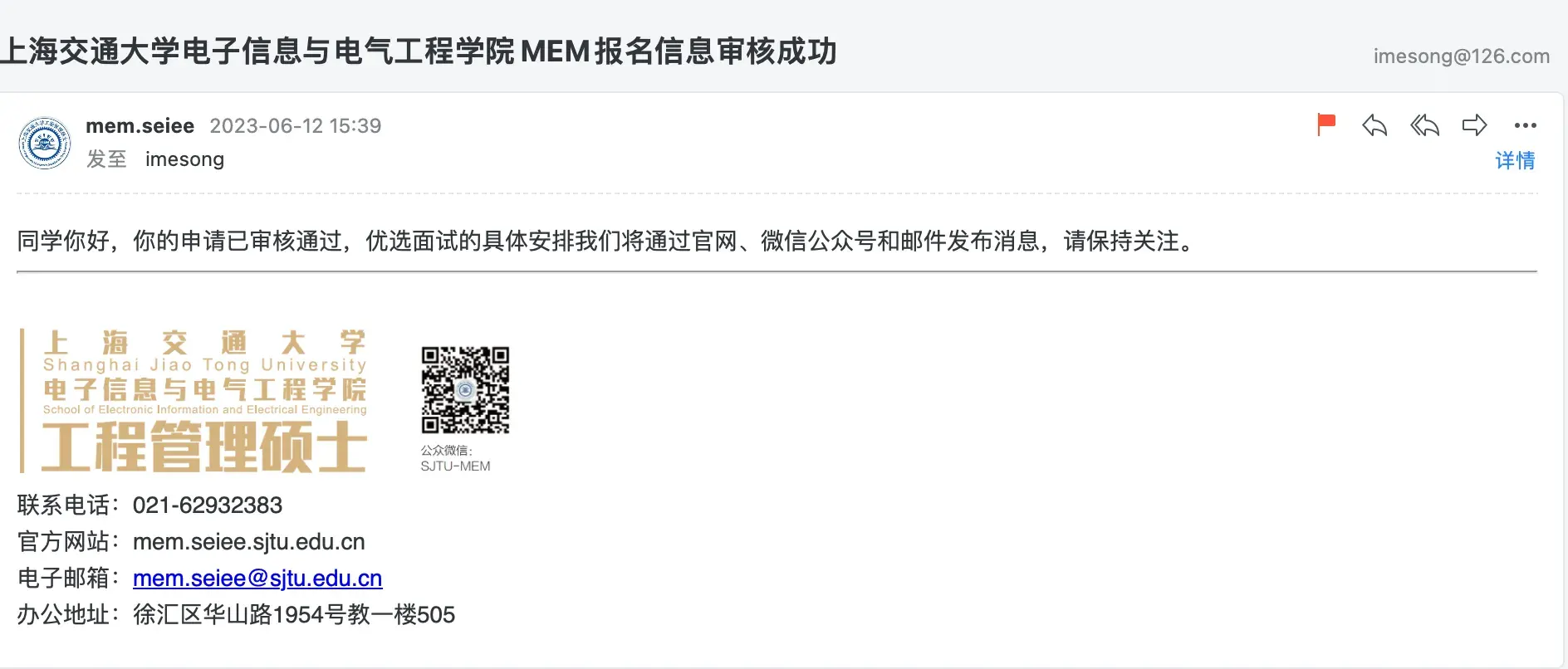
After finishing the basic materials, submit them as early as possible within the submission window. Once submitted, your application goes into the review process. After it passes review, you will receive an email confirming successful registration. All that remains is to prepare well for the interview.
My Interview Preparation
My interview preparation had two parts:
- Enriching the content of my application materials with detailed, concrete examples.
- Personal mock interviews: doing some basic preparation for questions I might be asked, especially hot topics (international current affairs, the TikTok ban, etc.) and classic questions (key achievements, strengths, future plans). This turned out to be well worth it — several questions in the actual interview had been prepared in advance.
- English preparation, mainly covering: self-introduction, describing my daily work, hot topics, and so on.
Questions the interviewers might ask
- Data compliance and security: how do you view the US ban on TikTok? (asked)
- The AI boom: how do you view ChatGPT’s impact on the industry?
- Problems in internationalization (asked)
- Depth of management ability, breadth of business (asked)
My Interview Experience
I attended the second batch of the SJTU MEM preferred interviews for 2024 admission. The interview was on July 2 (Sunday). Probably because I submitted my materials relatively early, I was placed in the second group of the morning session.
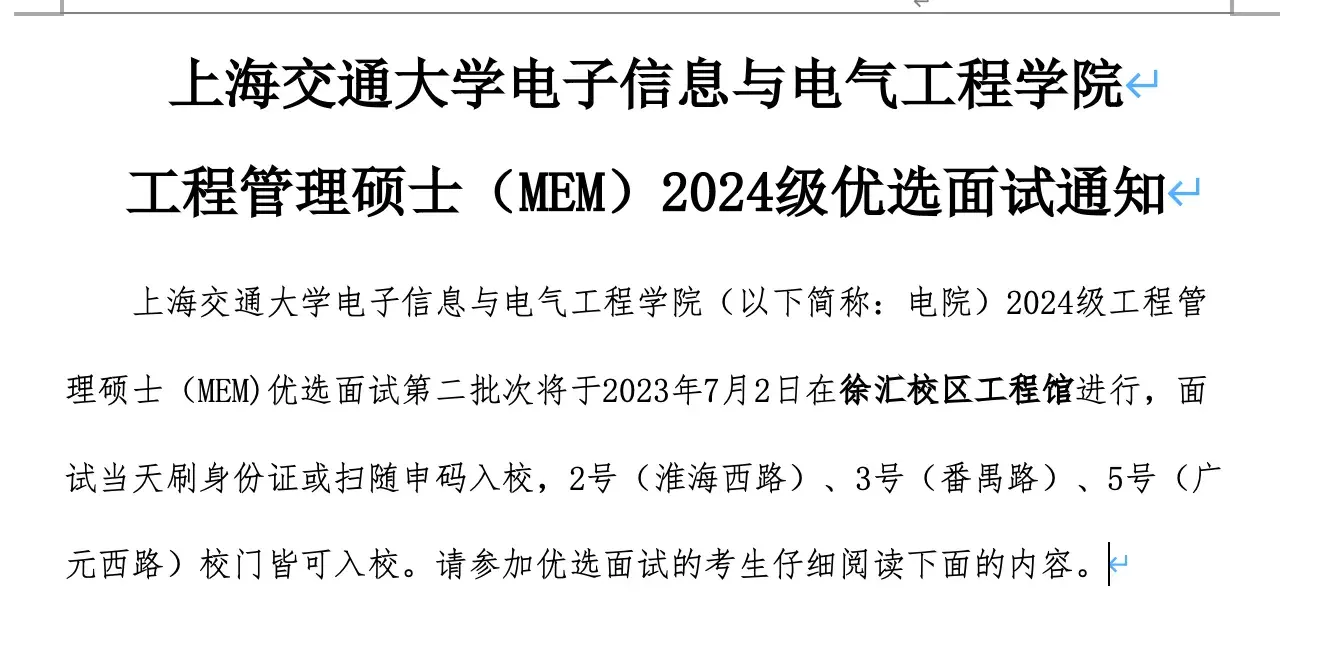
Interview time, location, and process

Interview grouping
Interview Process
The interview process has five main parts. You need to print five copies of your application materials yourself.
- Check-in: sign in and confirm your interview classroom
- Pick up your interview card: wait for the interview
- The interview: ~
- Return the interview card: calm your racing heart
- Done: time to go home
The questions I was asked
- A five-minute self-introduction
- English questions
- What is your main advantage compared with the other candidates?
- Your main achievements at work
- What is your main job? I spent a long time explaining to one of the professors what TikTok’s international e-commerce “is,” “how it works,” and “what I am mainly responsible for in the team.”
- What are the main challenges in your work, and how did you solve them?
- What problems do you face working in a cross-border team, and how do you solve them?
- The challenges you face: being banned and suppressed abroad
- Do you hold any patents or software copyrights?
- Open-source projects: a personal assistant built on ChatGPT (text summarization and abstraction)
- Why do you want to study MEM, and what are your future plans?
I will not share reference answers to these interview questions. At the end of the interview, one professor said to me: “Your preparation materials aren’t very thorough; they’re a bit …” and another professor chimed in: “Yes, they look rather rough.” Hearing this, I immediately thought: “Oh no, I’m done for this time. I’ll have to write up a lessons-learned post about failing instead.”
Later I thought about why the professors said that. Compared with other candidates, I probably hadn’t submitted enough supplementary materials — award certificates, papers, software copyrights, and so on. My application materials were only two sheets of A4 paper, and to fit everything onto two pages, I had used fairly abstract wording, even some internet-industry “jargon” — language that the professors may not have found appealing.
I do have some certificates, but I personally feel they don’t carry much weight, so I only mentioned them in the application materials and didn’t submit the originals.
- CET-6 (College English Test Band 6) certificate
- PMP
- Software copyrights and patents
As for supplementary materials, I suggest that everyone prepare as thoroughly as time allows, and try to show the original documents to the professors during the interview — at the very least, it’s a bonus.
Follow the WeChat public account 技术后花园 (Tech Backyard) for more information.