This is a summary of Y Combinator’s RFS (Request for Startups) published in early 2025 (February 3). The original is here: https://www.ycombinator.com/rfs . If you’re interested in AI and want to explore opportunities in the AI industry or projects you could build, I hope this article gives you some inspiration and direction.
TL;DR

Full Text
At YC, we often discuss ideas we’d like to see more people try. Occasionally, we compile these ideas into a list called a Request for Startups (RFS), a YC tradition going back many years. This page collects those ideas.
Please don’t feel you must pick one of these ideas to apply to YC. We expect these ideas to make up only a small fraction of what we fund — but if one of them particularly excites you, we hope its potential inspires you to go for it.
 Spring 2025
Introduction
Progress in AI over the past few months has opened up many new opportunities for startups. We usually publish a Request for Startups once a year, but this time we decided to publish another within three months to help founders seize the emerging idea space.
You’ve probably followed the relevant breakthroughs. With Operator and Computer Use, AI systems can now use computers. Reasoning models such as OpenAI’s o1/o3 and DeepSeek R1 give AI systems the ability to surpass humans. These new technologies also demand entirely new computing infrastructure, and DeepSeek R1 demonstrated the huge potential of low-level optimization.
These are the ideas we think are worth exploring in depth.
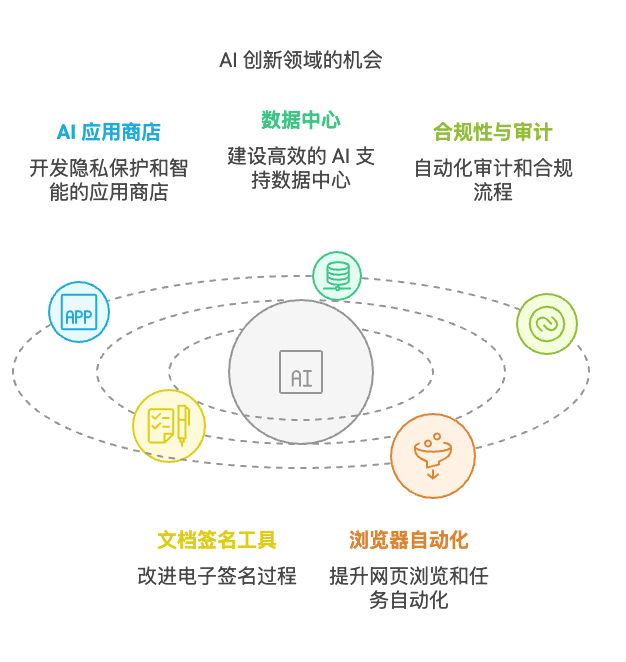
A New Vision for the AI App Store
We want a new kind of AI app store and operating-system layer that can be installed on your computer or phone. It should:
- Protect user privacy: users choose which apps can access their data — calendars, files, or browsing history — and data is only visible with the user’s authorization.
- A unified personal memory: all personal information (preferences, past actions, etc.) lives in this layer instead of being scattered across multiple apps.
- Help users discover great AI apps: the store reviews every AI tool, ensuring users can safely find and install them.
- Help developers build apps: provide infrastructure support so developers avoid rebuilding the same things — simple APIs for things like computer use, LLaMA version management, and app access control.
- Simplify payments: make paying for paid apps or services much easier.
Imagine a smart travel assistant that finds the best flights and knows you usually travel with your 9-year-old who loves window seats, or an AI reading assistant that, while you read an article, recommends the original piece where an idea was first proposed. Apps like these would use only the minimum data the user authorizes. A system like this makes AI powerful while protecting privacy.
Big tech companies may build such systems, but right now is the founders’ opportunity.
Done right, this creates more opportunities for startups: with shared memory, apps become smarter, and it also opens up new markets for distribution and monetization.
Data Centers
• *Diana Hu and Dalton Caldwell*
We need more data centers that can be built faster and at lower cost, to support the infrastructure AI development requires. Hyperscale data center construction usually takes years, and given the current market enthusiasm and available capital, we urgently need more new companies and innovative solutions to accelerate this process — across power supply, cooling systems, materials procurement, and project management.
We can envision a future where software manages the construction of data centers or warehouses, from site selection and construction to setup and ongoing management. All of this could run “hands-off,” with robots working around the clock.
We want to fund startups that help realize this vision.
Watch the video about data centers
Compliance and Auditing
In the US and Europe, roughly 4 million people (1% of the total workforce) work in compliance and auditing. Meanwhile, compliance costs keep climbing. From GDPR to Dodd-Frank, from financial AML/KYC to ESG reporting, the global regulatory environment keeps expanding.
Traditional compliance work usually involves reading lengthy regulations, cross-checking internal policies against procedure documents, manually spot-checking work records, and producing repetitive reports. Auditors often have to wade through large volumes of unstructured data, looking for potential problems. These tedious, time-consuming workflows badly need automation.
Large language models (LLMs) have already shown enormous potential in this area. They can quickly parse complex regulations, company policies, or financial statements, flag potential issues, and save manual review time. These tools can automate what auditors currently do by hand: detecting data anomalies, identifying incomplete records, or pointing out contradictory policies.
Instead of spot-checking a few documents one by one, a well-trained model can review everything at once — providing every company with “continuous auditing.”
Watch the video about compliance and auditing
DocuSign 2.0
Every day, signing complex documents (tax forms, sales contracts, mortgages, employment contracts, NDAs, loan applications, insurance applications, etc.) causes real headaches for individuals and businesses: existing products like DocuSign are too complicated in these situations and offer a poor user experience, struggling to:
- Create document templates
- Avoid filling in duplicate information
- Fix errors in documents
- Understand complex terms
- Integrate with other software
We want founders to rethink how documents that need signatures are created and distributed in an AI-driven world.
Imagine a new set of tools:
- Take any signed document, strip out the variable parts, and create a new document template.
- Automatically fill in information the user has provided before or that is publicly available.
- Help users understand complex terms through a voice assistant.
- Customized document templates that adapt themselves to the signer or the situation.
If you’re interested in building DocuSign 2.0, apply to YC.
Watch the video about DocuSign 2.0
Browser and Computer Automation
AI agents can now browse the web and operate desktop applications. OpenAI’s Operator and Anthropic’s Computer Use have proven this, and many open-source solutions offer the same capability.
Giving AI agents access to the internet is like giving a brain “hands.” They can now do many things.
This means every website and every application can now be treated as an API. Anything a human can do on a computer, AI can automate.
This greatly expands where AI agents can be used. We can’t wait to see what you’ll create.
Watch the video about browser/computer automation
AI Personal Assistants: Personal Services for Everyone
Software has always been an effective way to give the masses services once reserved for the rich. For example, before 2009, only the world’s wealthiest people could hire a private driver; now services like Uber and Waymo give everyone access to something similar. Another example: while working on Google Photos, I was surprised to learn that rich people hired someone specifically to curate, edit, tag, and organize their photos. We automated that process with AI, bringing the service to billions of people.
Despite the huge progress software has made across many fields over the past decade, the rich still employ many personal assistants providing customized services: tax accountants, private lawyers, financial managers, personal trainers, private tutors, even private doctors.
Why can only the rich enjoy these services? Because until now, software couldn’t replace this kind of high-end, customized knowledge work — until today’s AI finally can.
In the coming years, we expect AI to take on most of this personalized knowledge work. So if you’re building services that bring AI assistants to every ordinary person, we’d love to hear your ideas.
Watch the video about AI personal assistants
Building Developer Tools for AI Agents
Over the past two years, we’ve funded many startups using AI to disrupt traditional industries.
Now we’re witnessing the arrival of the next wave: AI agents — not just assistants to humans, but systems that can make decisions autonomously. With o1 and the upcoming o3, these agents’ reasoning abilities have improved dramatically, fully replicating or even surpassing the tasks humans perform.
AI agents will be everywhere across industries and in our daily lives. Imagine a world where everyone has a dedicated team of AI agents collaborating seamlessly in the background, boosting personal productivity and creativity.
To accelerate this future, we want to fund startups dedicated to building developer tools for AI agents. These tools could include:
• Agent building tools: companies that let users easily create and deploy custom agents, such as Wordware (YC S24) or Stack AI (YC W23).
• Agent building blocks: tools, APIs, or platforms that enhance agents’ capabilities, letting them perform more complex tasks and achieve greater impact.
If you’re building in this space, we’d love to hear your ideas and help you shape the future of software.
Watch the video about building developer tools for AI agents
The Future of Software Engineering
Large language models (LLMs) can now write code better than most people. This will drive the cost of software development down to nearly zero.
So will agents replace software developers? The answer is no! We’ll still need more software engineers in the future, because software will control almost everything.
These engineers will no longer write much code directly; instead, they’ll manage a team of AI agents that write and ship software for them. Beyond writing code, agents will take on all the other specialized tasks in the software development process: quality assurance (QA), deployment, security and compliance audits, translation, operations, and more.
We want to fund startups that can help small, generalist development teams manage large fleets of AI agents to develop and deliver massive amounts of software together.
If you’re interested in building tools for the future of software engineering, we’d love to talk with you.
Watch the video about the future of software engineering
AI Commercial Open-Source Software (AICOSS)
There’s a clear pattern in open source and open-source startups. First came proprietary Unix systems, then Linux, then RedHat; first BitKeeper, then Git, then GitHub and GitLab.
Today there are huge opportunities in open-source AI: building startups that provide support and services to help people use open-source AI.
Usually, organizations that release open-source code don’t focus on providing commercial support. For example, Google and Facebook have open-sourced many tools, but they don’t always focus on providing commercial support for these tools to enterprises — which creates opportunities for startups.
Many successful companies will emerge in open-source AI, especially after DeepSeek’s release; there will be many new areas waiting for founders to explore, helping companies make use of these systems.
If you’re interested in building in enterprise open-source AI, we’d love to hear from you.
Watch the video about AI commercial open-source software
AI Coding Agents: Hardware-Optimized Code
• Diana Hu
AI hardware is still constrained by software. Much of Nvidia’s advantage comes from its hand-optimized CUDA code used in AI models. Competing hardware — like AMD or custom chips — often underperforms, not only because the chips themselves are weaker, but because writing system-level code (kernels, drivers) is extremely complex, and far too few software engineers do this work.
Now, however, with the arrival of reasoning models like DeepSeek R1 and OpenAI’s o1 and o3, they can generate hardware-optimized code that matches or even surpasses human CUDA code.
We want to see more founders working on AI-generated kernel code, so that more hardware platforms can better support AI.
This isn’t just about performance — it’s about breaking dependencies. Founders working in this space have the potential to reshape the entire hardware ecosystem.
Watch the video about AI coding agents
B2A: Software That Serves Agents as Customers
A significant share of internet traffic today comes from non-human programs that scrape information, fill out forms, or search for updates while disguised as humans. Most people build websites with human users as the primary audience, not these bots.
As AI and agents become widespread, building software and services for agent customers seems increasingly important — customers who are not edge cases, but an actively supported and documented customer base.
For example, building APIs that help agents pay hosting fees, book travel, or sign contracts with other parties. In the stock market, trading between humans and programs has long been the norm, and this will only become more common in the future.
If you’re interested in building software and services specifically for agents, we’d love for you to share your ideas with us.
Inference AI Infrastructure: Meeting Test-Time Compute Demand
• Diana Hu
Until recently, compute spending was concentrated on pre-training foundation models. But with the launch of DeepSeek R1 and OpenAI’s o1 and o3, a new scaling trend has emerged, showing that we’ll need much more compute at inference time — when AI applications actually use these models.
As API call volumes from AI applications explode, infrastructure costs will become a serious problem.
That’s where new startups can provide solutions. We need to rebuild the tech stack in this area: better software tools at the inference layer, more economical ways to handle GPU workloads, and optimization techniques that let AI applications scale without facing enormous costs.
These unglamorous but critical problems often lead to huge business opportunities.
Watch the video about inference AI infrastructure
Follow the WeChat official account Tech Backyard for more.