About the Book
While browsing a Sisyphe bookstore over the weekend, I spotted this book, Schrödinger’s Cat, in the recommended section and was instantly drawn in by the title. Although I studied science and engineering, my knowledge of quantum mechanics goes no further than the name and the anecdote about Schrödinger. I flipped through the table of contents for a quick scan: the first two chapters seemed fairly interesting, introducing several basic concepts of quantum mechanics and even forcefully dragging in parallel universes. I had also watched a few of the movies quoted in the book. Later, I saw the book was available on WeRead, so I found some time and finished it in an hour and a half — a little disappointing. Let me excerpt some sentences and viewpoints from the book and briefly write down my own understanding.
What Did Schrödinger’s Cat Actually Do?
Before discussing the book’s content, I’d like to share what Schrödinger’s cat is really about.
In a sealed box, there is a cat and a bottle of poison. If the bottle is knocked over and the poison takes effect, the cat will surely die; if the poison is not spilled, the cat will live on normally. Until we open the box, we don’t know whether the cat is dead or alive. At that moment, the cat’s state is unknown — it can be understood as a superposition of being both dead and alive. Only at the instant the box is opened does the cat’s state collapse from “both dead and alive” into one definite state: dead or alive.
This experiment is mainly used to explain superposition and the observer effect in quantum mechanics. Superposition was just covered: in quantum mechanics, many a particle 🌰 can exist in multiple states at the same time. (🌰 is a Chinese pun: 栗子 “chestnut” sounds like 例子 “example”, so the emoji is often used to mean “for example”.) The observer effect means that the act of observation itself can influence the outcome. In everyday life, an observer can also be a participant who affects people’s performance — for example, the proctor in an exam or the referee in a match may influence how the participants perform. At the same time, this experiment tells us that the real world is not as simple as what we observe; the world we perceive may well be just one of its many states. It also reminds us to keep an open mind and accept uncertainty, especially when making decisions about complex problems.
The Life Algorithms of the Masters
Win Rate
Many things in life can be simplified into two outcomes: success and failure. When judging how likely something is to succeed, we can describe it with a win rate. Win rate == successes / (successes + failures)
Many factors influence our choices, and the three most obvious pitfalls are:
- Availability bias: deciding whether to choose something based on how easily it can be obtained. Correspondingly, we often hear the advice to “do the hard but right thing.”
- Sunk cost: deciding whether to choose something based on costs already invested in the past.
- Disposition effect: when disposing of investments, being more inclined to sell the winners while holding on to the losers.
Whether it’s availability bias, sunk cost, or the disposition effect, all of them make us irrational — unable to see the situation clearly, or even directly ignoring the win rate of an option — and consequently lead us to make wrong choices.
Odds
The odds are the ratio of an investment’s potential gain to its potential loss; they can be used to evaluate whether an investment is worth the risk. Friends who often buy lottery tickets or place bets will be familiar with this. For example: if you spend 100 yuan on a lottery ticket and win 400 yuan if you hit the prize, but lose the 100 yuan if you don’t, then the odds of buying the ticket are 400/100 = 4. When the odds are greater than 1, it’s profitable; when they’re less than 1, it’s definitely a losing proposition.
But when we make choices, we rarely look at odds alone — we usually consider them together with the win rate. Otherwise, spending a few yuan on a lottery ticket that could win millions would have such high odds that it would be a guaranteed profit, wouldn’t it?
Let’s use the earlier example again, combining odds and win rate. Principal: 100 yuan; odds: 4; probability of success each time: 0.3. If we want a positive expected return (to make money), what should we do?
Profit == Winnings — Losses Winnings = 0.3 _ 400 = 120 Losses = 0.7 _ 100 = 70 Expected profit per investment = 50
In this example, if you repeat this investment many times, you can expect to earn 50 yuan per investment on average.
Bet Sizing
Bet sizing = amount invested / total capital Another term related to bet sizing is “All in.” Whatever the matter, you should be cautious when going all in. When we don’t know how to decide on bet sizing, we can consider the Kelly criterion. f=(b×p-q)÷b, where f is the bet fraction, b is the odds, p is the win rate, and q is the loss rate (loss rate = 1 − win rate). If f is negative, the investment loses money in the long run; if f is positive, it gives the fraction to invest each time.
We encounter the three concepts of win rate, odds, and bet sizing frequently in life, but this is the first time I’ve seen them tied to life choices. The idea felt novel at first, but on reflection, life’s choices are far more complex than this and can’t be attributed after the fact to a single simple formula. That includes an example the book uses when introducing win rate, which shows a clear suspicion of deliberate oversimplification.
For something with only a 1% chance of success, if you repeat it 50 times, the probability of success rises to as high as 94%.
The reality might be: the success rate is 1% at the start, but by the time you make later attempts, the environment has changed, more participants have arrived, and the success rate has become 0.01%.
Find Your Donut
Find what you love, what you’re good at, and what society needs — then take the intersection of the three. That intersection is your sweet spot.
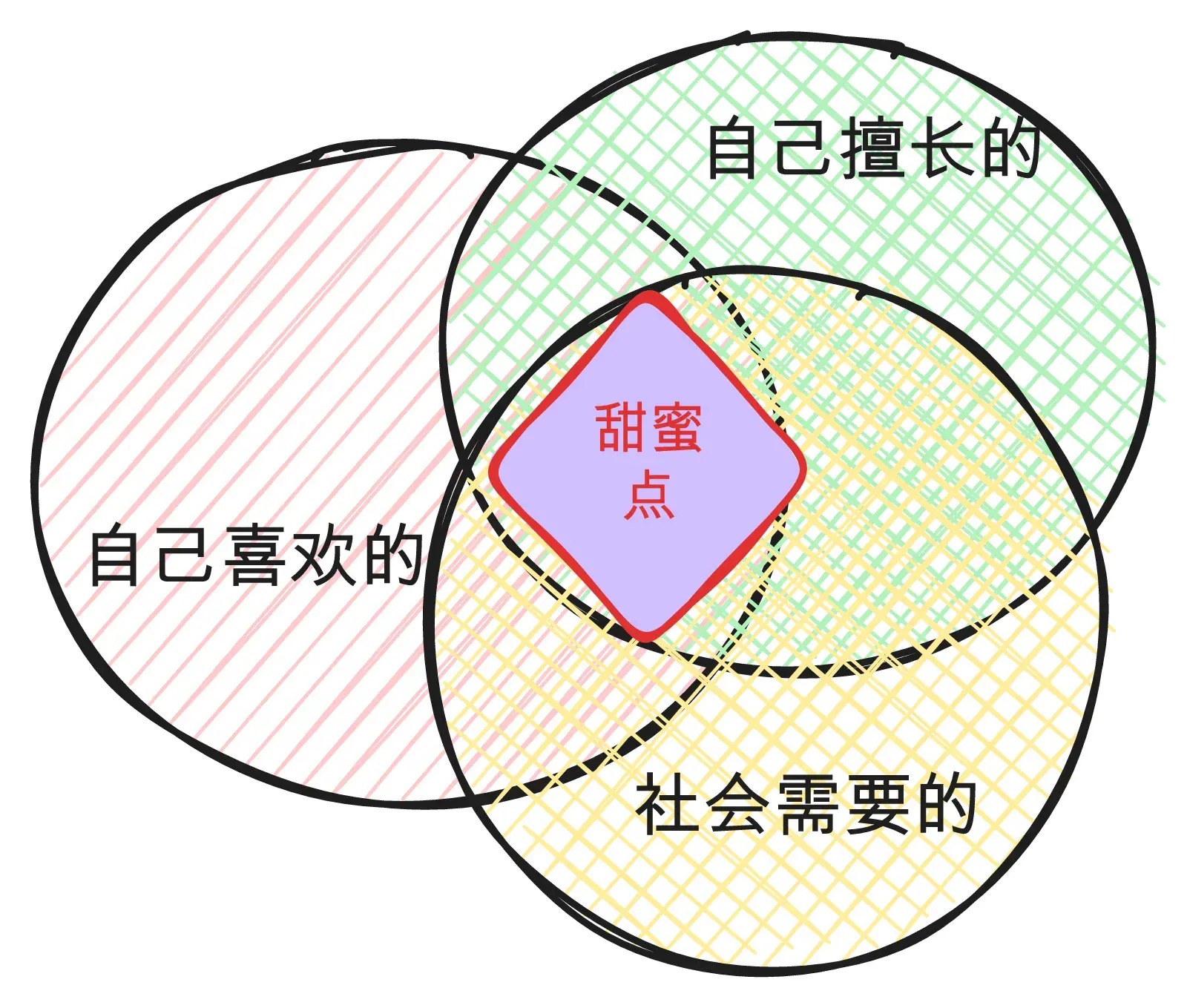
When you find your sweet spot, even if its single-shot win rate is tiny, it remains the thing you’re most willing to repeat. Even when you can’t get external feedback in the short term, the spiritual satisfaction you gain from doing it can still sustain you in carrying out your “plan of repetitions,” pushing your overall win rate higher and higher until you trigger a high-odds outcome and arrive at the place your heart longs for.
When our lives sit in different circles, how we feel is different.

The content above mainly covers the first chapter of the book Schrödinger’s Cat: Everything Is a Matter of Thinking Levels. There are four more chapters, but after reading them I didn’t care for them — they were mostly the same points rehashed over and over. Overall, I don’t really recommend this book.
Recommendation rating: ⭐️⭐️ Reading time: 90 minutes
Follow the WeChat official account 技术后花园 (Tech Backyard) for more